TNSDA Excavation Uncovers Ancient Manufacturing Centre in Karivalamvanthanallur
The Tamil Nadu State Department of Archaeology (TNSDA) has uncovered evidence of a continuous, ancient industrial manufacturing settlement during its ongoing excavation at Karivalamvanthanallur.
The discoveries reveal a unique regional cultural trajectory that bypassed the Neolithic and Chalcolithic phases, showing continuous occupation from the Microlithic period through the Iron Age and into the Early Historic and Historic periods. This sequence mirrors discoveries at sites such as Mangudi, Sivagalai, and Adichanallur.
The historical significance of Karivalamvanthanallur was first recorded nearly a century ago when Roman coins were reported in the region. L A Cammiade, the then Tirunelveli Deputy Collector, surveyed the area, and the Madras Museum's 1932-33 annual report subsequently documented glass beads and burial urns collected from local residents.
In the current excavation, the TNSDA has opened 18 trenches. According to School Education and Tamil Development Minister A. Rajmohan, more than 100 artefacts have been recovered over the past three months. These include microlithic stone tools, shell bangles, terracotta spindle whorls used in weaving, terracotta discs, terracotta and coral beads, a gold bead, rectangular gaming pieces, iron artefacts, and copper coins.
Archaeologists have also recovered hematite used for iron extraction, iron implements, large quantities of glass beads, terracotta figurines, graffiti-marked pottery, and black-and-red ware. Minister Rajmohan stated that the structural evidence suggests workshops for iron tool-making, bead manufacturing, shell bangle production, and weaving were active in the region during the Sangam period.
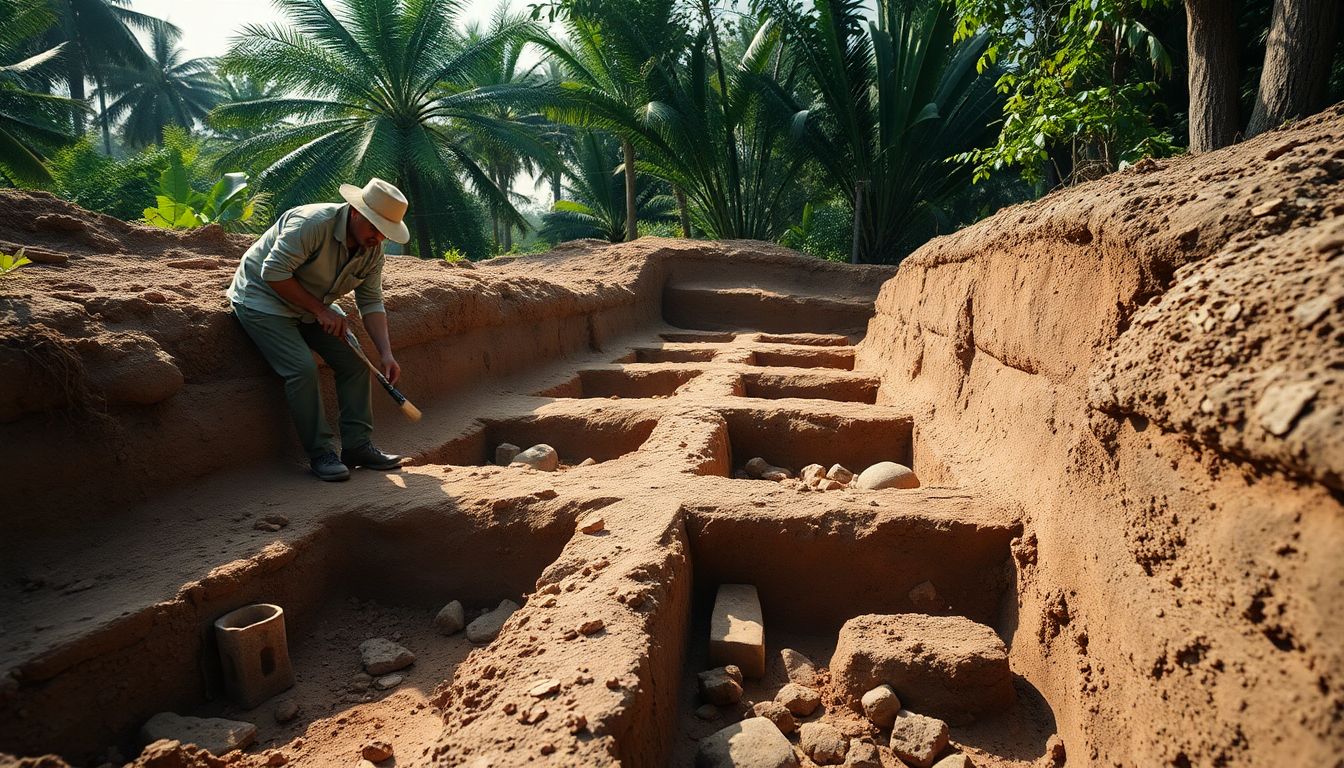
Among the structural finds is a large brick structure measuring about 8.7 metres by 4.2 metres, built with bricks measuring 40 x 20 x 7 centimetres. The structure features descending steps and is believed to have served as either an underground granary or a rainwater harvesting tank. Its brick style resembles structures found at Keeladi, Alagankulam, and Poompuhar. Carbon-dating samples from this structure have been sent to Beta Analytical Laboratory in Florida.
Another notable find is a red-slipped burial pot decorated with painted peacocks on its shoulder. Molar and premolar teeth recovered outside the vessel, along with a black-and-red ware pot placed beneath it, suggest it functioned as a burial urn. Similar peacock-decorated vessels have been associated with burials at Porunthal and Harappan contexts, while Sangam literature, specifically Akananuru, also references decorating memorial stones with peacock feathers.